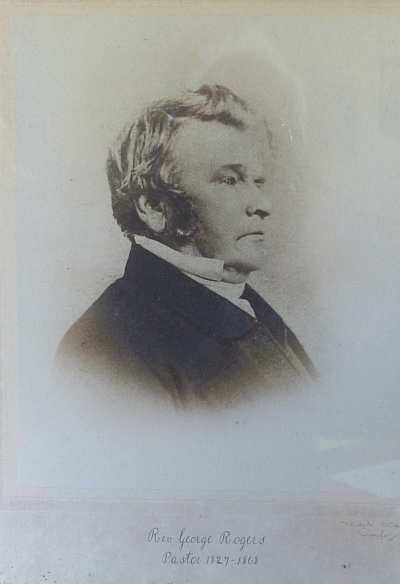
 Zion's Hill Independent (latterly Presbyterian Church of Wales) Chapel, Bomere Heath This is a portrait of the chapel's first minister, the Rev. George Rogers, which was in the vestry of the chapel. There is a biography of him in: J. T. Jones, Geiriadur bywgraffyddol o enwogion cymru [Biographical dictionary of eminent Welshmen], 1867-70. Translated for me from the Welsh by the Rev. William Price. "ROGERS, George, Congregational minister in Bomere Heath, born in Maenclochog, Pembrokeshire, 25 December 1795. Having had his religious training, he joined the Congregational church in Haverfordwest, in 1816, where his parents had moved to live. Soon after this he devoted himself with all his energy to be a teacher in the Sunday school, among several other Christian ventures which were taken forward by the church. As an assistant preacher his service was very acceptable and approved. After consulting his uncle, the Revd B. Howell, who was at one time a minister in the Congregational church in Bere Regis, Dorset, he resolved to give himself entirely to the ministry and to give up his wordly calling. In 1822 he went to Carmarthen academy. For his work after leaving there in 1827 he was sent to a small number of Congregationalists, who had come together as a church in Bomere Heath, Shropshire. In that place he settled for the rest of his life; after arriving in the place he began to collect money to build a chapel there; he worked so energetically that the chapel was opened in July 1827. On 1 May 1828 he was ordained minister. Mr Rogers endeavoured strenuously to preach in the villages for many years; at one time he had no fewer than eleven places in which he held religious services at regular times. One of his stations was in Harmer Hill, a village about three miles from Bomere Heath. The prospects there were extremely hopeless, but a chapel was built and opened there on 29 April 1834. A church was established there, and Mr Rogers was minister in the united churches of Bomere Heath and Harmer Hill. In relation to the latter there was built for him a house, where he took his residence, while he did the work of a minister quietly and faithfully in the land where he spent many years of his life. In 1859 because of failing health he had to give up his ministry in Harmer Hill, but he kept Bomere Heath, where he continued to live until his death. For a few years after moving he was able to fulfil his ministerial duties in one place; but at the beginning of 1864 through the decrepitude of old age he had to give up his care of the chapel completely; but following this he recovered so much of his habitual strength that he was frequently able to help in the work of preaching, and on the day before he became ill with his last illness (Sunday July 12th 1868) he ministered with great approval in Hadnal (sic) chapel, where he had been accustomed many years previously to preach often. Next day he became very ill and died in Jesus on 21st. His whole life was marked by untiring endeavour. He was a strong nonconformist, always ready to defend his principles. He refused a living in the church of Scotland which was seriously offered to him." |
All the photographs on this website are copyright and may not be reproduced without the permission of the copyright owner.
Permission for Michael Hulme to take photographs of the interior of the chapel was kindly given by elder Mr Ron Haynes. Photograph © Michael J.Hulme 2020.
To return to the main page, click here